Whqt Are Side Effects of Not Having Your Esophagus Being Attached as a Baby
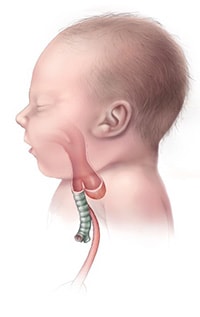
Esophageal Atresia Blazon C
Click hither to view a larger image
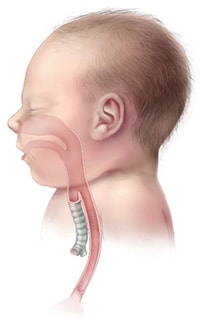
Normal Esophagus
Click hither to view a larger image
What is Esophageal Atresia?
Esophageal atresia is a birth defect in which part of a babe's esophagus (the tube that connects the oral cavity to the stomach) does not develop properly.
Esophageal atresia is a birth defect of the swallowing tube (esophagus) that connects the oral fissure to the breadbasket. In a baby with esophageal atresia, the esophagus has two split sections—the upper and lower esophagus—that do not connect. A baby with this birth defect is unable to pass food from the mouth to the stomach, and sometimes difficulty breathing.
Esophageal atresia often occurs with tracheoesophageal fistula, a birth defect in which part of the esophagus is continued to the trachea, or windpipe.
Types of Esophageal Atresia
There are iv types of esophageal atresia: Type A, Type B, Type C and Type D.
- Type A is when the upper and lower parts of the esophagus do not connect and accept closed ends. In this type, no parts of the esophagus attach to the trachea.
- Blazon B is very rare. In this type the upper function of the esophagus is attached to the trachea, only the lower part of the esophagus has a closed stop.
- Type C is the most common type. In this type the upper function of the esophagus has a airtight cease and the lower function of the esophagus is attached to the trachea, every bit is shown in the cartoon.
- Blazon D is the rarest and most severe. In this type the upper and lower parts of the esophagus are not connected to each other, but each is connected separately to the trachea.
How Many Babies are Born with Esophageal Atresia?
Researchers estimate that about 1 in every 4,100 babies is born with esophageal atresia in the United States.1This birth defect tin occur solitary, but often occurs with other birth defects.
Causes
Like many families of children with a nativity defect, CDC wants to detect out what causes them. Agreement the factors that tin can increase the chance of having a baby with a birth defect will help u.s. learn more than about the causes. CDC funds the Centers for Nascency Defects Research and Prevention, which collaborate on large studies such as the National Nascency Defects Prevention Study (NBDPS; births 1997-2011) and the Nativity Defects Study To Evaluate Pregnancy exposureS (BD-STEPS; began with births in 2014), to understand the causes of and risks for nativity defects, including esophageal atresia.
The causes of esophageal atresia in virtually babies are unknown. Researchers believe that some instances of esophageal atresia may exist caused past abnormalities in the babe's genes. Nearly half of all babies born with esophageal atresia accept 1 or more than additional birth defects, such as other problems with the digestive system (intestines and anus), heart, kidneys, or the ribs or spinal cavalcade.2
Recently, CDC reported on important findings about some factors that increase the take chances of having a babe with esophageal atresia:
- Paternal age – Older age of the male parent is related to an increased run a risk of having a babe built-in with esophageal atresia.3
- Assisted reproductive technology (ART)external icon – Women who used ART to go pregnant have an increased risk of having a infant with esophageal atresia compared to women who did not use ART.4
CDC continues to study birth defects, such as esophageal atresia, and how to prevent them. If you are significant or thinking about becoming pregnant, talk with your doctor almost ways to increase your chances of having a healthy babe.
Diagnosis
Esophageal atresia is rarely diagnosed during pregnancy. Esophageal atresia is most commonly detected after birth when the baby first tries to feed and has choking or vomiting, or when a tube inserted in the babe's nose or mouth cannot pass down into the tummy. An ten-ray can confirm that the tube stops in the upper esophagus.
Treatment
Once a diagnosis has been made, surgery is needed to reconnect the two ends of the esophagus and then that the infant tin can breathe and feed properly. Multiple surgeries and other procedures or medications may exist needed, particularly if the baby's repaired esophagus becomes as well narrow for food to pass through it; if the muscles of the esophagus don't work well enough to move food into the stomach; or if digested food in the stomach consistently moves back upwardly into the esophagus.
References
- Mai CT, Isenburg JL, Canfield MA, Meyer RE, Correa A, Alverson CJ, Lupo PJ, Riehle‐Colarusso T, Cho SJ, Aggarwal D, Kirby RS. National population‐based estimates for major nativity defects, 2010–2014. Birth Defects Enquiry. 2019; 111(eighteen): 1420-1435.
- Chittmittrapap S, Spitz 50, Kiely EM, Brereton RJ. Oesophageal atresia and associated anomalies. Arch Dis Child. 1989;64(3):364-68.
- Green RF, Devine O, Crider KS, Olney RS, Archer N, Olshan AF, Shapira SK; National Birth Defects Prevention Written report. Association of paternal age and risk for major congenital anomalies from the National Birth Defects Prevention Study, 1997 to 2004. Ann Epidemiol. 2010 Mar 31;20(three):241-9.
- Reefhuis J, Honein MA, Schieve LA, Correa A, Hobbs CA, Rasmussen SA. Assisted reproductive technology and major structural nascency defects in the United States. Hum Reprod. 2009 February 1;24(two):360-6.
Source: https://www.cdc.gov/ncbddd/birthdefects/esophagealatresia.html
0 Response to "Whqt Are Side Effects of Not Having Your Esophagus Being Attached as a Baby"
Postar um comentário