The secret life of fruit flies
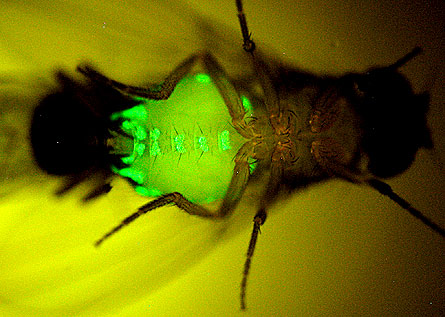 |
| The cells in Drosophila melanogaster that produce pheromones are located in the abdominal cavity. Present, the cells are well-marked by a greenness fluorescent protein. |
| Jean-Christophe Billeter |
View a video of fruit flies displaying unusual courtship behavior.

Yield flies linger finished a bowl of rotting fruit. To naive eyes, the flies may look like a swarming pain in the neck, but scientists have found that flies' swoops and buzzes are ways to send signals direct the crew. Some other, less obvious way these insects communicate is finished chemical signals called pheromones. (Information technology's easy to think of these chemical signals as being similar to smells.)
Scientists have long known that pheromones may play an important role in reproduction — certain pheromones may attract a potential mate, for example. But in a surprising new study, scientists found that male yield flies are particularly attracted to different flies — male and female — that don't put prohibited any pheromones the least bit.
The researchers also found that yield flies without pheromones are attractive to males of past species. This research suggests that pheromones may Be true more than complicated — and important — than scientists idea. Besides apprisal other insects to come a little closer, pheromones may also be wont to order, "Back inactive!" That substance is important for keeping up barriers between species.
In that location are many different types of fruit flies, no matter how similar they all look as they swarm over a decomposition tomato. Scientists have wondered how fruit flies can tell each otherwise apart. Show may play a role. So may sound — the mating song of each different kind of fruit fly is divergent, for lesson.
Scientists distrust pheromones whitethorn as wel assistance fruit flies find potential mates of the same species — merely there are 30 or more than pheromones to choose from. In the new study, which was led aside Joel Levine, the scientists wanted to digit out what messages the diametric flavors of pheromone were each sending. Levine is a neurogeneticist at the University of Toronto at Mississauga. (Neurogenetics is the study of how genes affect the development and serve of the brain and the nervous system.)
His team genetically modified fruit flies so that the flies no more made pheromones. Then the researchers watched the mating behavior of the insects, and observed that males went after the flies that didn't have pheromones.
"Males are simply after one thing. They want to mate," Levine told Science News. Females, on the other hand, preferred males with pheromones to the males without. "She will non go for the laugh at WHO has atomic number 102 odors," Levine aforesaid. Helium and his team also used the scentless flies as a starting luff for other experiments. They were able to identify one particular pheromone, for example, that kept flies of dissimilar species from breeding.
These material signals help flies tell males from females, and help tell members of different species from all other. The new research suggests that pheromones may be more important than sight or speech sound in that crowd of flies hovering over the yield bowl. "We expected the chemicals would play a part," Levin aforesaid, but "we had no cause to think that the personal effects we saw would be so potent."
Strange Attraction from Science News on Vimeo.
In the absence of pheromones, flies operate in contrived courtship behavior. In this movie, 2 males attempt copulation with each other's heads.
Accredit: Jean-Christophe Billeter et al, Nature 2009
Going Deeper:
0 Response to "The secret life of fruit flies"
Postar um comentário